
In every organization, teams are expected to deliver high-quality work on time. Yet, the reality is that resources are limited, priorities shift, and workloads fluctuate.
This is where effective team capacity planning becomes essential. When leaders understand how much work their teams can realistically take on, they can allocate resources efficiently, set achievable timelines, and reduce the risk of burnout.
Besides, team capacity planning isn’t just an operational step—it’s a strategic advantage that helps businesses stay productive, predictable, and healthy.
This article explores strategies for effective team capacity planning, from understanding the fundamentals to applying practical techniques that work for teams of all sizes and industries.
Understand the concept: What is team capacity?
Team capacity refers to the total amount of work a team can complete within a specific timeframe—often weekly, monthly, or per sprint for Agile teams. This capacity is shaped by several factors, including the number of team members, their available working hours, their skills, and the complexity of the work they’re assigned.
Additionally, to understand team capacity is to look beyond simple availability. It means considering real-world variables such as meetings, training, the mix of skill sets, and performance patterns.
The better these factors are understood, the more accurately leaders can forecast what the team can achieve.
1. Factors that influence team capacity
Actual team capacity is rarely fixed. It fluctuates based on internal and external factors. When leaders understand these variables, they are better equipped to plan and adjust.
1.1 Planned absences
Vacation days, holidays, training sessions, and company events all reduce available capacity. Good planning requires visibility into upcoming absences and adjusting workload accordingly.
1.2 Unplanned absences
Sick leave or unexpected emergencies can immediately impact a team’s ability to deliver. While these cannot be predicted with certainty, leaders can build contingency plans for critical roles or tasks.
1.3 Meetings and operational duties
Meetings, reviews, standups, administrative work, and customer support responsibilities all consume time that cannot be allocated to deep work. Therefore, leaders must factor in these recurring commitments when estimating capacity.
1.4 Skill availability and bottlenecks
If only a few members can perform a certain task, that skill becomes a bottleneck. Recognizing these dependencies allows teams to distribute work more strategically or plan for cross-training.
1.5 Team experience and performance trends
New team members, varying seniority levels, onboarding periods, and historical productivity trends all impact capacity. For example, a team that recently completed intensive training may perform more efficiently than before.
2. How does it compare with capacity planning?
While the terms sound similar, there is a key difference:
- Capacity planning usually refers to organizational-level forecasting. It looks at long-term needs such as workforce planning, infrastructure scaling, or overall production capacity.
- Team capacity planning is more tactical. It focuses on individual teams, the actual work they can deliver, and how leadership can maximize productivity while respecting limits.
For example, a company might conduct capacity planning to determine hiring needs for the next year. Meanwhile, a project manager would use team capacity planning to decide how much work their team can deliver in an upcoming sprint or project cycle.
How team capacity is measured
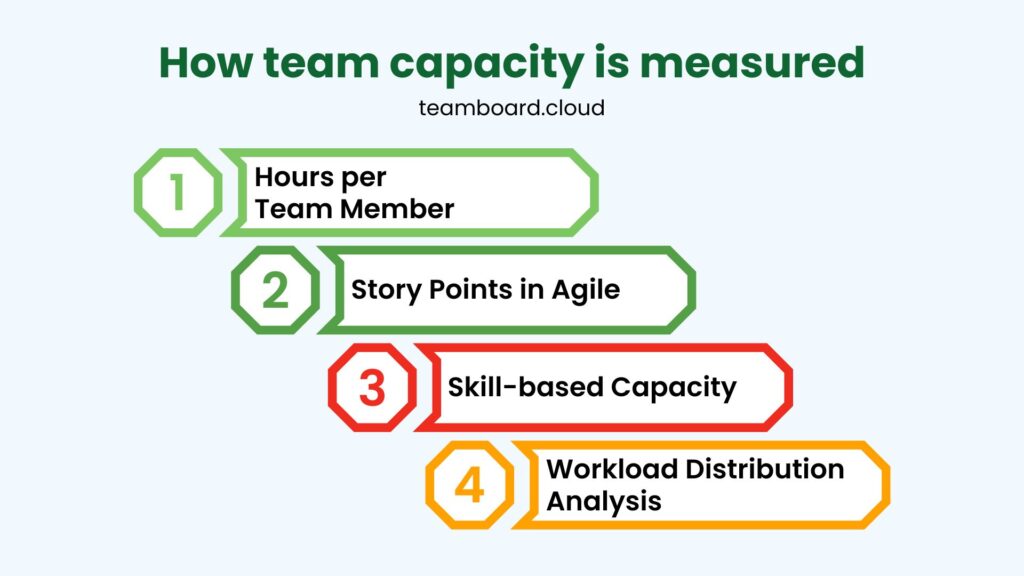
Different teams measure capacity in different ways depending on the nature of their work and the frameworks they use. Here are the most common methods.
1. Hours per team member
This is the most straightforward approach. Leaders calculate each person’s available working hours within a period, subtract time spent on meetings or other non-work tasks, and total the remaining hours.
For example, a team member with 40 working hours per week might realistically have only 28–32 hours available for focused project work after considering meetings and ongoing support tasks.
2. Story points in Agile
Agile teams often use story points, a relative measure of effort and complexity. Capacity is based on the team’s historical velocity—how many story points they typically complete within a sprint.
This method shifts the focus from time to productivity and acknowledges that effort doesn’t always correlate directly with hours.
3. Skill-based capacity
Some teams rely heavily on specialists, such as designers, DevOps engineers, or data analysts. In these environments, capacity must be measured not only by total hours but by the availability of specific skill sets.
For instance, if a project requires frontend development but only one frontend developer is available, the entire team’s capacity hinges on that specialist’s availability.
4. Workload distribution analysis
Rather than measuring individual capacity alone, leaders may analyze how work is distributed across the team. This helps identify imbalances—such as one team member being overloaded while others remain underutilized—and supports more equitable assignments.
Benefits of team capacity planning
1. Prevents overload and burnout
When workload exceeds capacity, teams become stressed, quality declines, and turnover increases. Capacity planning helps leaders proactively prevent overload by matching expectations with reality.
2. Improves predictability and delivery accuracy
By basing timelines on real capacity, rather than assumptions, teams are more likely to meet deadlines and deliver consistent results.
3. Optimizes resource allocation
Leaders can assign tasks to the right people based on skill, availability, and workload balance, thereby improving resource use.
4. Enhances transparency and collaboration
Capacity planning makes workloads visible and encourages open discussions about priorities and constraints. This creates a more collaborative culture.
5. Increases strategic decision-making
Capacity insights enable leaders to plan —whether it’s redistributing tasks, scaling the team, or adjusting project scopes.
Strategies for effective team capacity planning
Effective team capacity planning goes beyond just tracking working hours or assigning tasks. It requires a thoughtful approach that balances the team’s capabilities, skill sets, and the workload demands of each project.
When done correctly, capacity planning leads to more predictable project timelines, optimized resource allocation, and healthier work environments.
1. Assess the team’s actual available hours
The first step in effective capacity planning is accurately determining how many hours each team member has available for project work.
While a team member may have a full 40-hour workweek, it’s important to subtract time spent in meetings, training, administrative duties, and support activities. A team member might only have 28–32 hours available for focused project work, even if they are contracted for 40 hours.

In addition to regular work hours, planned absences—like vacation days and holidays—must also be factored into the overall capacity. This visibility helps project managers avoid overestimating what can be accomplished.
Moreover, keeping track of planned absences and unplanned disruptions, such as sick leave, allows teams to adjust workloads and timelines accordingly, ensuring capacity estimates are as accurate as possible.
2. Evaluate team skills and work type
Team capacity is not only about available hours; it’s also about the skills required for specific tasks. Specialized tasks, such as software development, UX design, or data analysis, may require expertise that not all team members can provide. Understanding your team’s skill distribution is critical for effective capacity planning.
By mapping out team capabilities and identifying skill gaps, managers can allocate tasks more effectively. Besides, it can ensure that work is assigned to individuals with the right expertise.
For example, if a task requires frontend development but only one team member is skilled in that area, the entire team’s capacity may be constrained by that individual’s availability.
Additionally, teams with a high concentration of specialists may face bottlenecks if the demand for specialized work is greater than their availability. Balancing work between specialists and generalists, and ensuring that tasks match the right skills, will maximize the team’s overall capacity and efficiency.
3. Prioritize and break down work
Another critical element of capacity planning is prioritization. Not all tasks are of equal importance or complexity, and it’s essential to understand which tasks should be given priority. Using frameworks like MoSCoW (Must-have, Should-have, Could-have, Won’t-have) helps distinguish between critical and less critical tasks, ensuring the team focuses on high-priority work first.

In addition to prioritization, breaking down large or complex tasks into smaller, more manageable components is essential. When tasks are too vague or broad, it’s difficult to estimate how much time they will require, leading to inaccurate capacity forecasts.
Breaking these tasks into smaller, clearly defined units allows for more accurate estimates and a better understanding of how they fit into the overall project timeline. As a result, the team can more effectively gauge their capacity to complete them, helping to avoid overloading individual team members with smaller, bite-sized tasks.
Besides, smaller tasks also help improve flexibility and efficiency, as they can be reassigned or adjusted with less disruption if needed. This makes it easier for managers to adapt to unforeseen challenges or changes in the project.
4. Use tools and visual methods
Relying on manual methods for capacity planning can lead to inefficiency and confusion. Using digital tools like Jira, Trello, or TimePlanner helps streamline the planning process by providing a centralized location to manage tasks, track capacity, and monitor progress.
These tools typically offer features like workload distribution graphs, team calendars, and burndown charts that give leaders and team members real-time visibility into the team’s available capacity. These visual aids help project managers spot potential imbalances—such as one team member being overloaded while others have available time—and adjust workloads before problems arise.
In addition to software, visual tools such as Gantt charts or simple spreadsheets can be effective for tracking capacity. These methods make it easier to see the entire team’s workload and availability at a glance, which improves communication and helps the team stay aligned.
5. Continuously monitor and adjust
Capacity planning should be treated as an ongoing process, not a one-time task. Teams face constant changes—unexpected absences, shifts in project scope, or new priorities—which can all impact the team’s ability to deliver. As a result, leaders should regularly monitor team performance and capacity throughout the project, adjusting plans as necessary.
For Agile teams, this is often done during retrospectives or sprint reviews, where team members reflect on what went well and what can be improved. These reviews provide valuable feedback on how well capacity estimates aligned with actual work completed, and where adjustments may be needed.
Regular check-ins help identify issues early on, such as tasks taking longer than expected or a team member becoming overloaded.
6. Encourage everyone’s involvement in team capacity planning
An often overlooked aspect of capacity planning is involving the team in the process. While project managers can assess workload and availability, it’s the team members themselves who have the most accurate understanding of their own capacity and potential limitations.
Additionally, encouraging team members to participate in capacity planning discussions creates more realistic expectations and helps prevent overloading. By giving team members a voice in capacity decisions, leaders foster a greater sense of ownership and accountability.
Not only that, team members can provide valuable insights into potential roadblocks, skill gaps, or areas where they may need additional support. This open communication ensures that workload distribution is fair and that the team remains engaged throughout the planning process.
7. Align team capacity planning with long-term goals
Effective team capacity planning isn’t just about managing short-term project timelines—it’s also about supporting long-term business goals. By analyzing capacity trends over time, leaders can identify when the team might be at risk of burnout, when additional resources may be needed, or when capacity could be optimized further.
For example, if a team consistently works at or near full capacity, it may be time to consider expanding the team, hiring additional resources, or redistributing responsibilities. Similarly, if the team consistently has spare capacity, leaders can explore opportunities to take on additional work or assign more complex tasks.
Aligning capacity with long-term business goals ensures that the team remains adaptable and responsive to changing business needs.
Conclusion
Team capacity planning is one of the most powerful tools a project manager or team leader can use to improve delivery outcomes, reduce stress, and support sustainable productivity. By understanding how capacity is measured, recognizing the factors that influence it, and applying practical strategies, leaders can ensure their teams work smarter—not harder.
Effective capacity planning requires visibility, communication, and continuous adjustment. When done well, it creates healthier workloads, better collaboration, and more predictable results. These are the benefits that every business can leverage for long-term success.