
In today’s fast-paced work environment, teams are expected to deliver more—faster and with fewer resources. While this drive for efficiency can boost short-term results, it often comes at a hidden cost: team burnout.
According to the World Health Organization, burnout is now recognized as an occupational phenomenon resulting from chronic workplace stress that has not been successfully managed. Meanwhile, a 2023 APA report found that 77% of employees experience work-related stress, with 56% citing that stress is sometimes associated with workplace burnout.
One of the most overlooked contributors to burnout is poor capacity planning—specifically, the capacity planning trap many managers fall into. This happens when teams are planned at full capacity without accounting for real-world constraints.
This article explores how burnout and capacity planning are deeply connected—and how project managers can create a more sustainable, high-performing team environment.
Why team burnout is easier to happen than you think
Burnout is more than temporary fatigue or stress; it is a prolonged state of emotional, physical, and mental exhaustion caused by excessive and sustained workload. It typically manifests as a combination of emotional exhaustion, reduced motivation, and detachment from work.
And over time, individuals experiencing burnout may struggle to maintain productivity and engagement, which ultimately affects the entire team.
1. Common causes in project teams
In project environments, burnout often arises from systemic issues rather than individual limitations. Continuous overload, unrealistic deadlines, and competing priorities can create constant pressure.
Additionally, a lack of visibility into team workloads makes it difficult for managers to allocate work effectively. When combined with poor prioritization and the expectation to deliver under tight constraints consistently, these factors significantly increase the risk of burnout.
2. Early warning signs managers should watch
Burnout rarely happens suddenly; it develops gradually and can often be identified early if managers pay attention. Common warning signs include:
- Missed deadlines
- Declining quality of work
- Reduced participation in team discussions
- Increased absenteeism
A noticeable drop in communication or enthusiasm can also indicate that team members are becoming disengaged. Recognizing these signals early allows managers to intervene before burnout becomes severe.
Understanding the capacity planning rabbit hole
The capacity planning trap occurs when managers plan work based on ideal conditions rather than real-world constraints. This typically means assuming that team members are available and productive 100% of their working hours.
However, in reality, a significant portion of time is spent on meetings, administrative tasks, context switching, and unexpected interruptions. Ignoring these factors leads to plans that are overly optimistic and difficult to sustain.
1. Why teams fall into this trap
Despite best intentions, many teams repeatedly fall into the capacity planning trap—not because of poor management, but because of a combination of organizational pressure, limited visibility, and flawed assumptions.
- Pressure to maximize utilization: Plan at 100% capacity ignores meetings, interruptions, and real-world variability.
- Lack of accurate data: Make decisions based on assumptions rather than actual workload visibility.
- Overconfidence in estimates: Tasks are often underestimated, leaving no room for uncertainty or abrupt changes.
- Misalignment with business expectations: Set aggressive deadlines without fully considering team capacity.
- Normalization of overwork: Consistently overloading high performers becomes an accepted pattern.
2. Consequences of poor capacity planning
The consequences of poor capacity planning are both immediate and long-term.
Teams that are consistently overallocated experience chronic stress and fatigue, leading to burnout and increased turnover. Projects are more likely to face delays and quality issues, and trust between teams and stakeholders can erode.
How TimePlanner helps prevent team burnout
Effective capacity planning requires more than good intentions—it demands accurate data, clear visibility, and the ability to adapt quickly to change. This is where tools like TimePlanner play a critical role in helping project managers move from reactive workload management to proactive burnout prevention.
Step 1: Review your team’s actual capacity
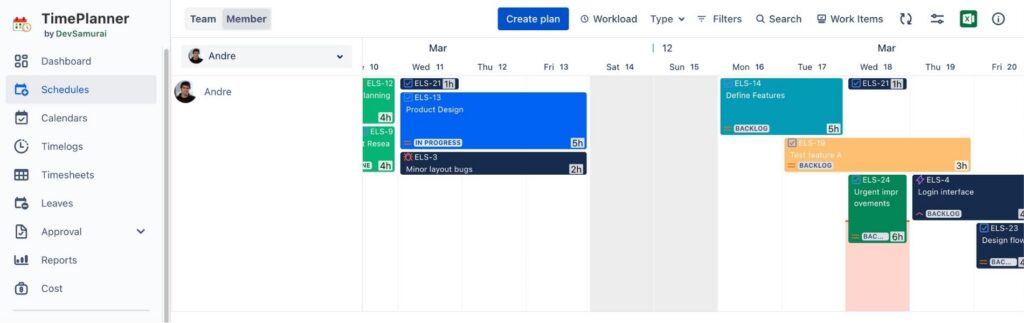
You can start by looking at each team member’s real availability in the app after planning tasks on the Schedules board. You can plan tasks on the board, set the capacity needed, and determine when they should be completed.
Additionally, this should also include not only working hours but also time off, public holidays, internal meetings, and other non-project responsibilities (such as attending workshop sessions). To account for those hours in the capacity planning, you can go to TimePlanner’s General settings, locate Capacity & Scheduling, and enable Allow Events in Schedules.
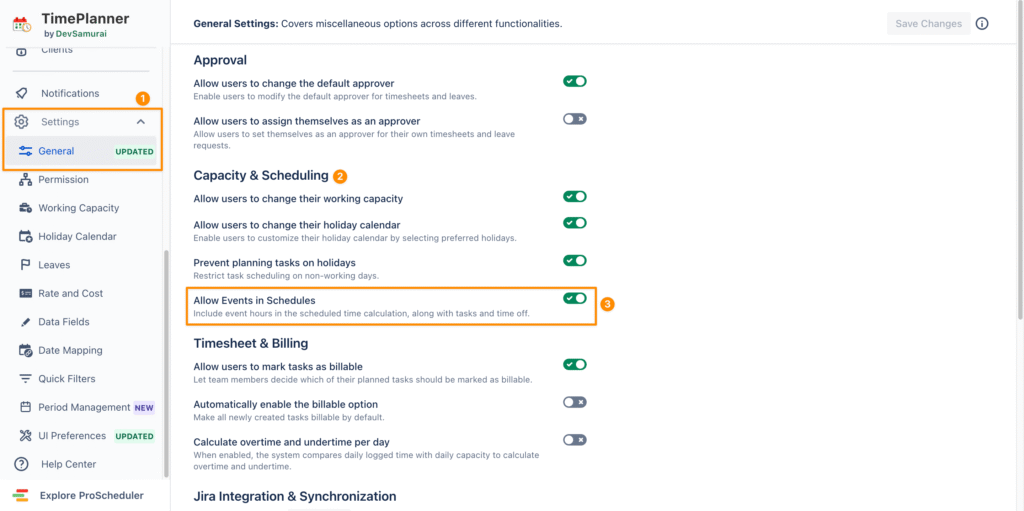
As a result, this helps project managers plan based on actual capacity rather than assuming everyone is fully available at all times.
Step 2: Spot overloaded team members early
Next, use TimePlanner’s workload view to identify who is overloaded and who still has available capacity (or underutilized). This workload visualization uses indicators with different colors to track the workload of each team member more effectively:
- Red (Overloaded workload): indicates members have more tasks than they can handle within a day.
- Green (Balanced workload): indicates that members have tasks assigned that perfectly match their available capacity for the day (although this could be too good to be true).
- Blue (Lighter workload): indicates that members are underutilized and their workload is below their capacity for that day.
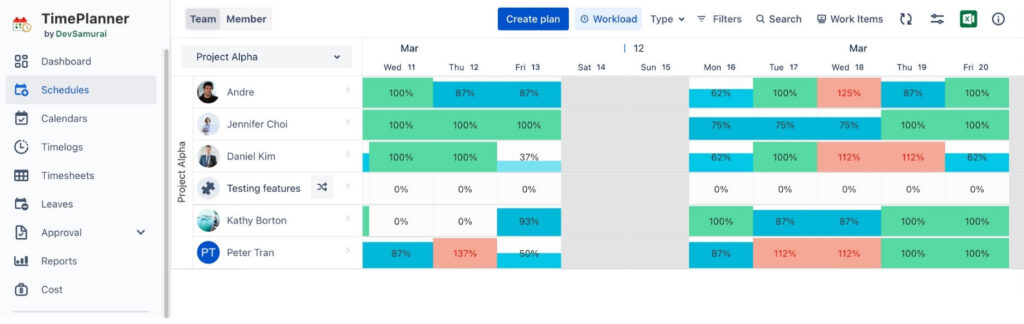
As a result, this makes it easier to catch overload before it turns into missed deadlines, stress, or disengagement. Instead of reacting to problems after they arise, managers can address risks at the planning stage.
Step 3: Balance work across the team
Once overload is visible, tasks can be redistributed more fairly. TimePlanner helps managers avoid putting too much pressure on only a few high-performing individuals in the team.
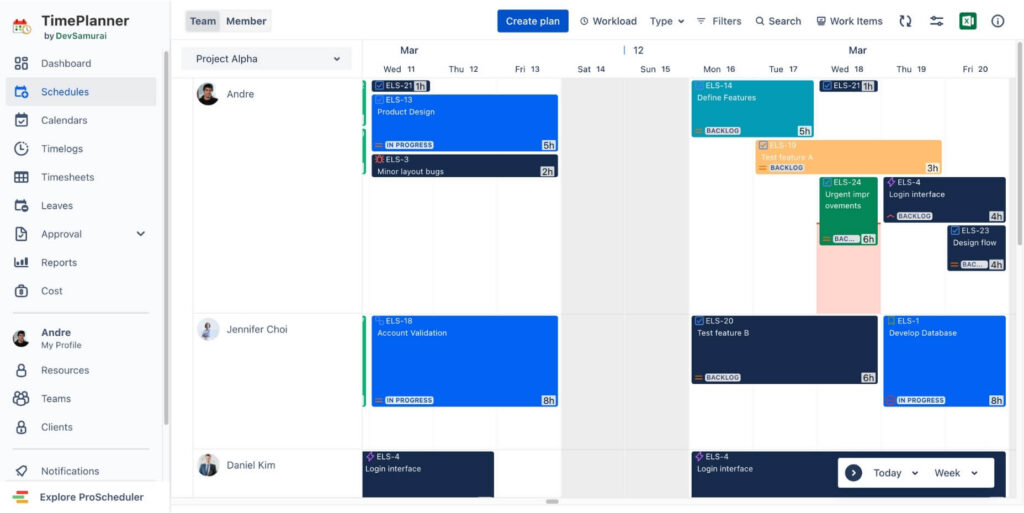
Instead, they can spread work across the team based on actual availability, sharing less important tasks with other members. This creates a more sustainable workload distribution.
Step 4: Plan with realistic timelines
With a clearer view of capacity, managers can set delivery timelines that reflect real working conditions. This reduces the habit of overcommitting the team and helps avoid constant last-minute pressure. Realistic planning is one of the most effective ways to prevent burnout over time.
Step 5: Prepare for changes in advance
Projects rarely go exactly as planned. There will always be urgent tasks or changes popping up while the project is underway, and they can easily eat up any availability left for your team.
Fortunately, TimePlanner helps managers look ahead and assess the impact of upcoming work, resource changes, or shifting priorities. This makes it easier to adjust plans early rather than forcing the team to absorb every change through extra effort.
Step 6: Create more transparency around workload
TimePlanner also helps build stronger communication by giving teams and managers a shared view of workload and capacity. When workload is visible, it becomes easier to have honest conversations about pressure, availability, and priorities before burnout becomes a bigger issue.
Key principles to avoid the capacity planning trap
Besides using TimePlanner to streamline your capacity planning to avoid team burnout, there are some factors you should keep in mind:
- Plan for real capacity, not maximum capacity: Account for meetings, time off, and admin work; aim for 70–80% utilization to keep plans realistic.
- Prioritize ruthlessly: Focus on high-impact work and remove low-value tasks to avoid unnecessary overload.
- Build buffer time: Always leave room for delays and unexpected work to reduce stress and keep delivery stable.
- Encourage sustainable work practices: Promote healthy habits and respect boundaries to maintain long-term performance.
- Improve workload visibility: Ensure clear visibility into workloads to balance tasks and identify overload early.
Conclusion
Preventing team burnout is not solely about supporting individuals; it is about creating systems and processes that enable sustainable work. The relationship between burnout and capacity planning is clear—unrealistic planning leads to overload, and overload leads to burnout.
By adopting realistic planning practices, leveraging tools for better visibility, and fostering a supportive team culture, organizations can achieve consistent and high-quality performance. Sustainable success does not come from pushing teams to their limits, but from enabling them to perform at their best over time.
In the end, effective capacity planning is not about doing more—it is about doing the right amount of work, in the right way, with the right expectations.