
Organizations today face a common challenge: How do you stay flexible, manage resources effectively, and deliver projects without creating chaos? One answer many businesses turn to is the matrix organization structure.
Matrix structures can help teams move faster, collaborate across functions, and respond to change. But they can also create confusion when not implemented correctly. With several types of matrix structures – and many variations – choosing the right one can feel overwhelming.
What’s a Matrix Organization?
A matrix organization is a structure where employees report to more than one manager at the same time. This dual-reporting setup is what makes a matrix different from traditional hierarchies.
Typically, employees have:
- A functional manager (such as Marketing Lead, HR Manager, Engineering Director)
- A project or product manager (who oversees the work for a specific initiative)
Instead of sitting inside a silo, employees shift between projects or initiatives, depending on business needs. This model is especially useful when work crosses boundaries – like when launching a new product, expanding into markets, or handling complex client projects.
→ Related article: Matrix Organization in Project Management | Example
Why organizations adopt a matrix structure
Companies embrace matrix structures because they help:
- Break down silos and improve cross-team collaboration
- Use people’s skills more efficiently
- Respond faster to new opportunities or problems
- Encourage knowledge sharing between functions
- Support complex, multi-layered projects
However, the dual-reporting system can also lead to confusion or stress if roles and communication aren’t clear.
A well-designed matrix can unlock huge benefits. A poorly managed one can slow everything down. That’s why choosing the right type matters.
Matrix Organization Structure Types
Matrix structures exist on a spectrum, based on how much authority functional managers and project managers have. The three core types – weak, balanced, and strong – represent different levels of influence and responsibility.
Let’s explore each type in depth.
Weak Matrix Organizational Structure
In a weak matrix, functional managers retain most of the decision-making power. Project managers act more as coordinators and have limited authority over resources or timelines.
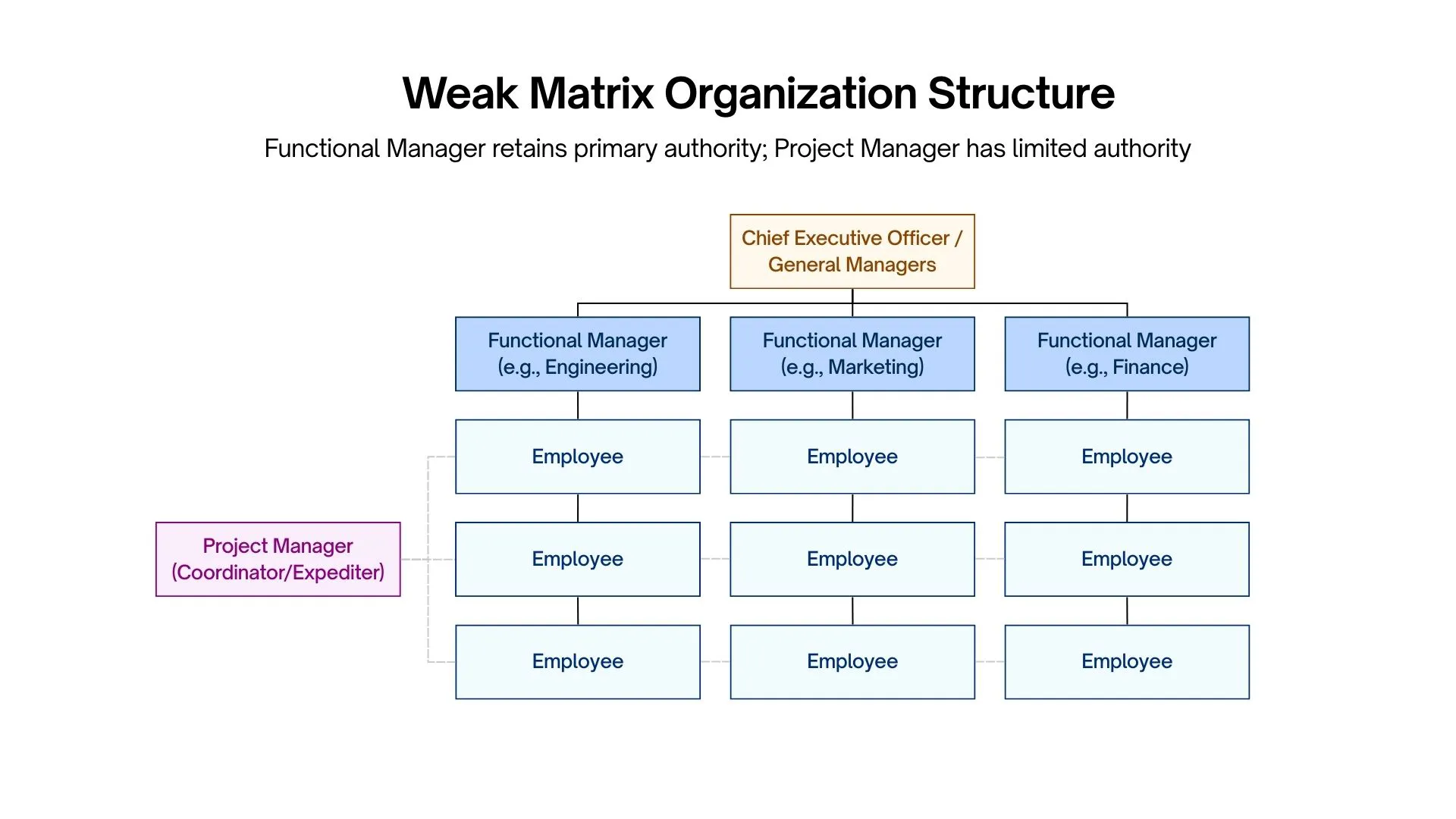
Weak Matrix Organizational Structure
Key characteristics:
- Functional managers control budgets, performance evaluation, and priority-setting.
- Employees stay deeply connected to their departments.
- Project managers provide scheduling and communication support but not direction-setting.
Why it fits certain organizations:
This structure is comfortable for organizations transitioning from traditional hierarchies. It introduces collaborative elements without requiring major power shifts.
Best suited for:
- Smaller organizations or early-stage businesses
- Teams with simple, short-term, or low-risk projects
- Companies where functional expertise is more critical than project speed
Balanced Matrix Organizational Structure
Balanced matrices distribute authority evenly between functional managers and project managers. Both sides collaborate closely to guide employees, allocate resources, and make strategic decisions.
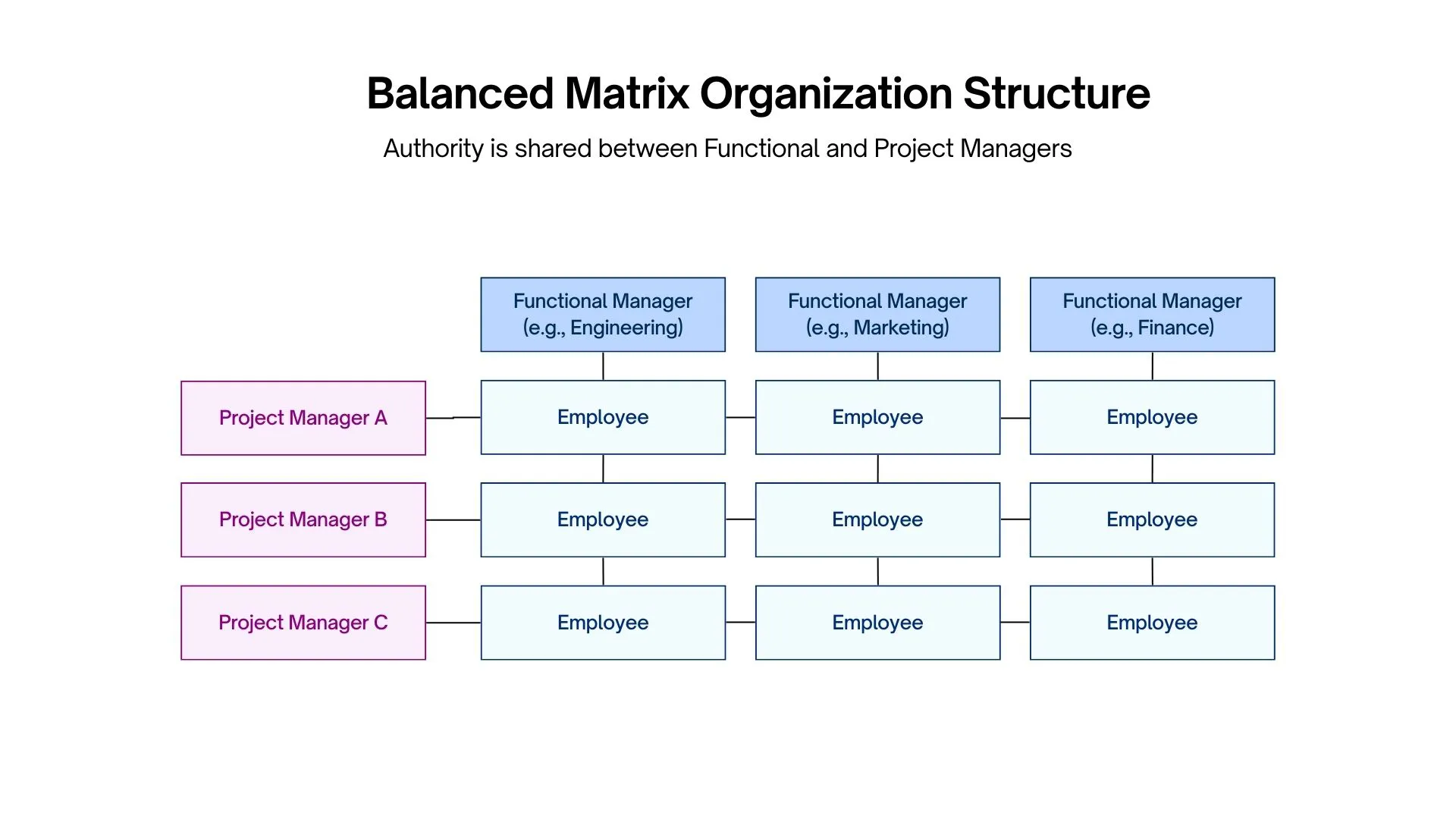
Key characteristics:
- Project and functional managers share power equally.
- Employees balance direction from both leaders.
- Decision-making is collaborative rather than centralized.
Why it fits certain organizations:
This structure supports organizations that need strong project coordination without diminishing functional leadership. It creates a partnership between departments and project teams.
Best suited for:
- Mid-sized companies running multiple complex projects
- Teams that rely heavily on cross-functional collaboration
- Organizations seeking a flexible yet stable structure
Strong Matrix Organizational Structure
A strong matrix gives most authority to project managers, who guide budgets, staffing, and execution decisions. Functional managers focus mainly on technical expertise and developing team members’ skills.
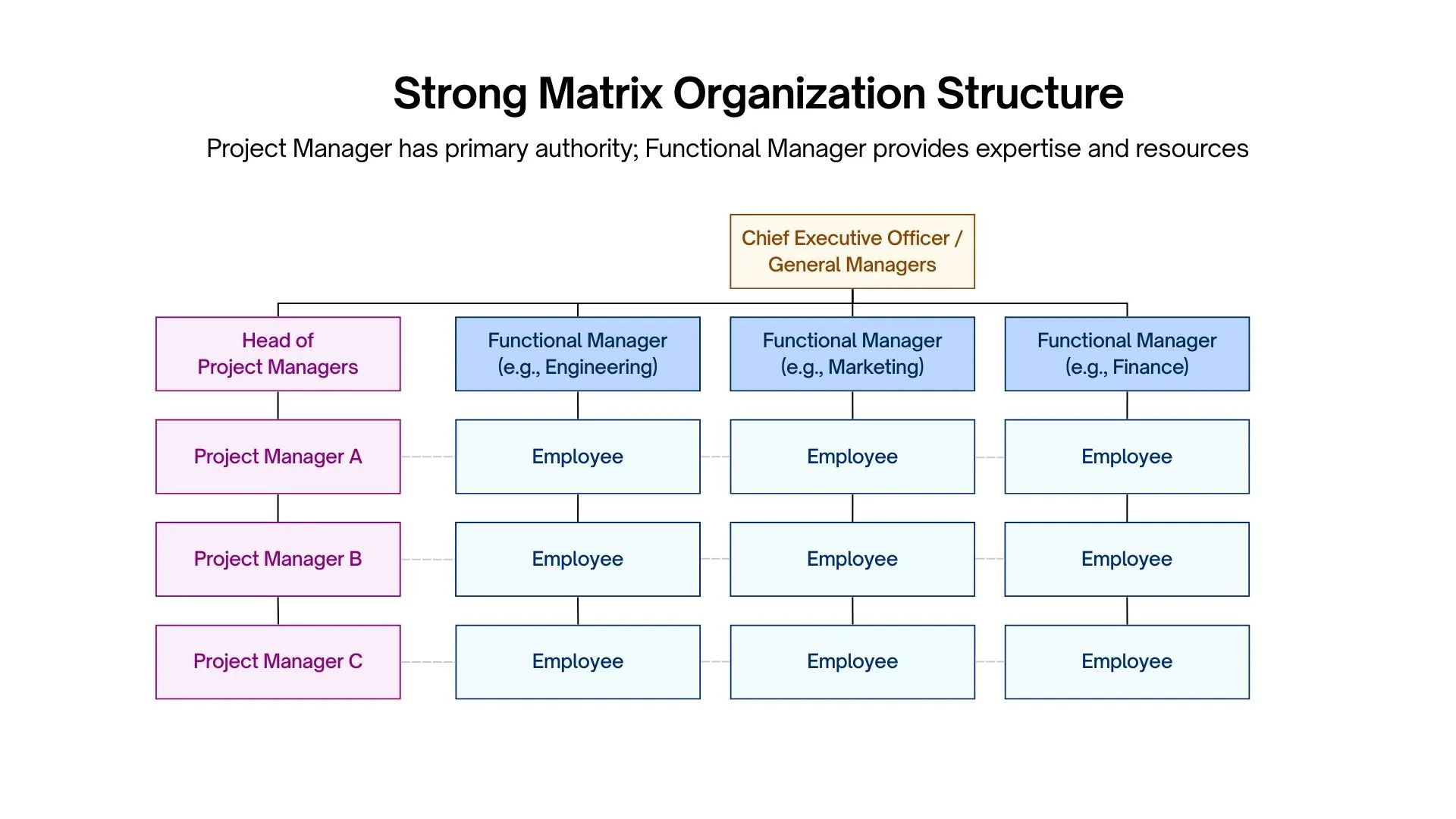
Key characteristics:
- Project managers act like mini-CEOs of their projects.
- Functional managers offer support but do not direct day-to-day work.
- Employees spend more time aligned to project needs than departmental goals.
Why it fits certain organizations:
It provides clear accountability and faster decision-making – ideal for industries where project outcomes drive business performance.
Best suited for:
- IT services, consulting, construction, and engineering
- Companies with large, long-running, or high-stakes projects
- Organizations that need rapid execution and decisive leadership
Additional Variations of Matrix Structures
Beyond the core three types, many companies use specialized variations tailored to their unique environments. Here are some of the most common and practical ones.
Multi-Dimensional Matrix
In this variation, employees may report across multiple dimensions – such as product, geography, and function simultaneously.
Where it works best
- Large enterprises with global operations
- Companies managing multiple business units or product lines
- Organizations needing high coordination between different markets
This model allows enormous flexibility but requires strong systems and communication to avoid overload.
Virtual Matrix
A virtual matrix connects teams across different locations, cultures, and time zones. It often combines functional, regional, and project-based reporting lines.
Where it works best
- Remote-first companies
- Global teams coordinating international projects
- Multinational corporations expanding into new regions
Clear communication tools and cultural awareness play a major role in making this variation successful.
Product-Based Matrix
Here, teams are organized around product categories while still maintaining functional expertise.
Where it works best
- Tech companies with multiple product lines
- Manufacturing firms with varied products
- SaaS businesses needing product-centric decision-making
This structure helps companies innovate faster while keeping functional knowledge consistent across products.
Skills Required to Make a Matrix Structure Work
A matrix structure succeeds only when the people involved have the right skills and mindset. These skills help teams navigate dual reporting lines and shared responsibilities smoothly.

Skills Required to Make a Matrix Structure Work
Key skills include:
- Communication: Clear, proactive communication prevents misunderstandings between employees and managers.
- Collaboration: Frequent teamwork across departments requires a willingness to share responsibility and information.
- Conflict resolution: Disagreements are normal – resolving them quickly keeps projects moving.
- Leadership alignment: Managers must work together instead of competing for influence.
- Time and workload management: Employees often juggle multiple tasks; prioritization skills are essential.
- Decision-making clarity: Teams should know who makes final calls in different situations to avoid bottlenecks.
- Flexibility and adaptability: Matrix environments shift frequently; employees need to stay open to change.
- Emotional intelligence: Awareness and empathy help maintain healthy cross-functional relationships.
When these skills are present, matrix structures run far more smoothly.
When to Use Matrix Organization Structure
A matrix structure is most effective when your organization faces these circumstances:
- You run multiple projects that need expertise from different departments
- Work frequently crosses functional boundaries
- You want better use of specialized talent
- You need more flexibility to respond to new opportunities
- Your environment changes quickly
- You need faster communication and collaboration
- Your resources are limited and must be shared across projects
If your projects require input from many functions – and speed matters – a matrix structure is often a strong fit.
Advantages of Matrix Organization Structure
Matrix structures can unlock several benefits:
- More efficient use of people and skills
- Better communication across departments
- Increased flexibility when priorities shift
- Stronger problem-solving thanks to diverse perspectives
- Faster project delivery under strong coordination
- Improved innovation through cross-functional collaboration
- Clearer alignment between functional skills and project needs
These advantages help organizations stay competitive in fast-moving industries.
Disadvantages of Matrix Organization Structure
Every structure has challenges. Common drawbacks include:
- Confusion or stress from dual reporting lines
- Competing priorities between project and functional managers
- Slower decisions if alignment isn’t clear
- Higher coordination effort
- Risk of employee overload without proper resource planning
- Potential for conflict when responsibilities overlap
The good news: most of these disadvantages can be reduced with the right workflows and tools.
Improve Your Matrix Structure with Project Management Tools
Matrix structures add complexity – especially when managing shared resources. That’s where smart project management tools come in.
Tools like ProScheduler help organizations keep everything aligned, visible, and predictable.
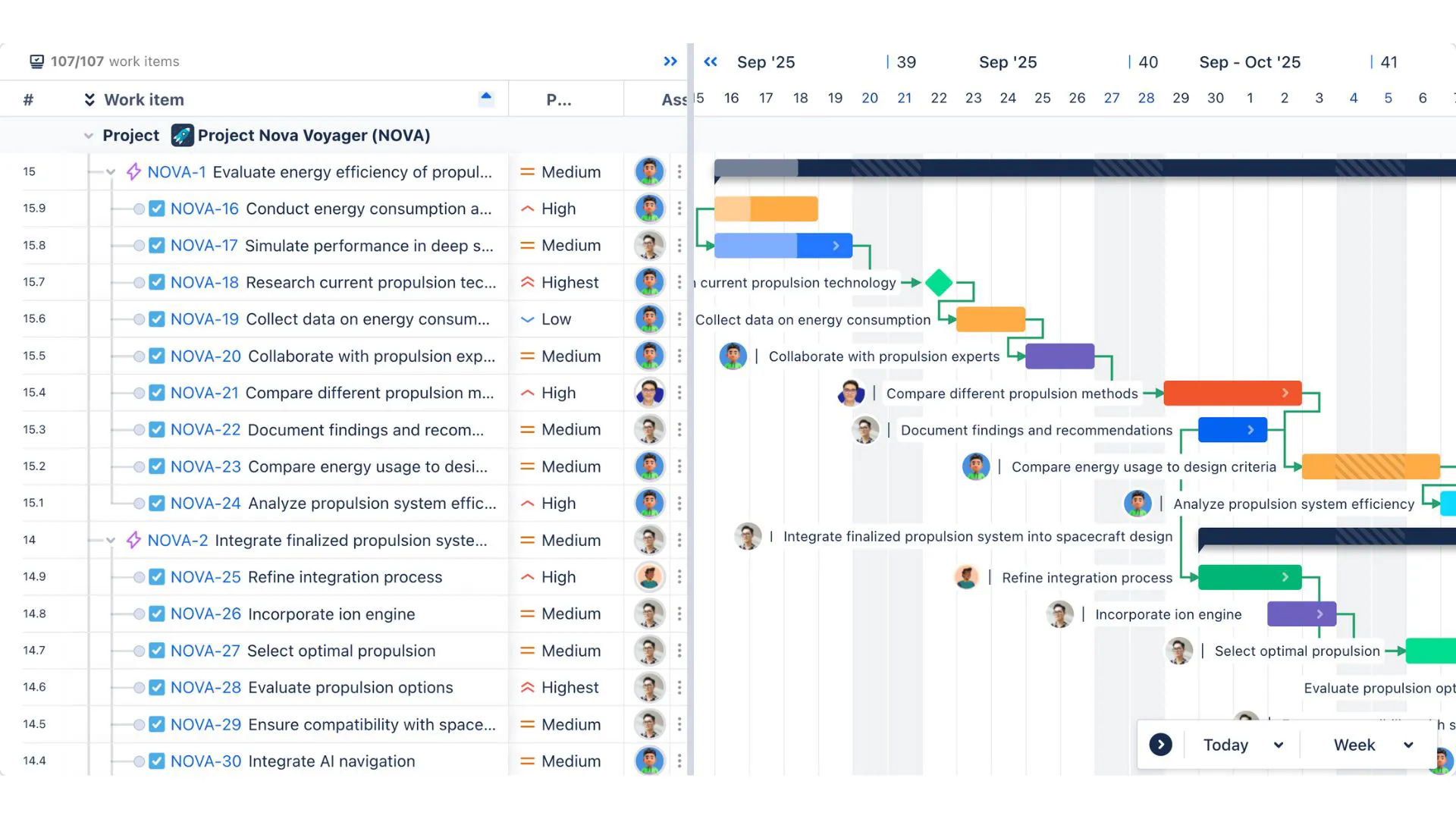
How ProScheduler supports matrix teams
- Resource planning becomes effortless – See who’s available, overloaded, or underutilized in real time.
- Clear role assignments – Reduce confusion by clarifying who does what and when.
- Timeline visibility – Plan schedules across multiple projects without conflicts.
- Better workload distribution – Prevent burnout by balancing responsibilities.
- Centralized communication – Keep updates, tasks, and decisions in one place.
- Cross-team collaboration – Ensure functional and project managers share the same information.
→ Manage your team resources right in Jira with ProScheduler. Try it for free.
When teams work across multiple streams and answer to different leaders, tools like ProScheduler provide the structure needed to keep everything running smoothly.
Final Thoughts
A matrix organization can be a powerful structure for teams that thrive on collaboration, flexibility, and shared expertise. Whether you choose a weak, balanced, or strong matrix – or one of the specialized variations – the model works best when people understand their roles, managers communicate openly, and the organization supports teams with the right tools.
Matrix structures aren’t about adding complexity; they’re about enabling smarter, more connected work. When done well, they help companies deliver projects efficiently, use talent more effectively, and adapt quickly to new challenges. With a clear setup and supportive tools like ProScheduler, your organization can turn a matrix structure into a strategic advantage rather than a source of confusion.