
Walk into any modern agile workspace or remote team stand-up, and you will likely see a familiar paradox: we have more productivity tools than ever, yet team burnout is sitting at record highs. As managers, the root cause we often overlook is a silent productivity killer: employee overload.
This isn’t an individual time-management flaw; it is a systemic organizational failure. When we push teams past their capacity without clear visibility into their actual bandwidth, we aren’t driving high performance—we are driving them toward the exit. Therefore, identifying the early warning signs and shifting toward data-driven resource planning can save thousands in turnover costs and preserve team morale.
Here is how you can spot the distinct signs of employee overload, understand its core drivers, and learn how modern capacity management tools like TimePlanner can proactively solve it.
What is employee overload?
Employee overload is a chronic state where the operational demands placed on a worker consistently exceed their physical, mental, or temporal capacity to fulfill them. It happens when the scale tips from a challenging, engaging workload to an unsustainable burden.
To manage this effectively, leaders need to recognize that overload typically manifests in two distinct dimensions:
- Quantitative overload: This is a pure capacity failure. It’s a math problem where the sheer volume of tasks, epics, or support tickets requires more time than the employee actually has available in a standard 40-hour workweek. It is the attempt to cram 60 hours of active work into a finite schedule, ignoring the reality of the clock.
- Qualitative overload: This occurs when the employee may technically have the hours, but the work itself demands an unsustainable level of continuous deep focus, lacks clear boundaries, or constantly forces intense context-switching. Jumping between strategic planning, answering urgent Slack messages, and fixing complex code bugs all within a single hour depletes cognitive reserves rapidly.
The myth of “high performance”
Managers often confuse a “high performer handling a heavy season” with a team member suffering from systemic overload. A heavy season has an end date; overload does not. We also call this the capacity planning rabbit hole, and it can make someone or even a whole team feel burned out real quick.
Furthermore, much of what pushes workers over the edge is “invisible work”—the unscheduled syncs, the administrative overhead, and the constant pivoting that never makes it onto a Jira board or project plan.
Effects of work overload
Ignoring employee overload is an expensive mistake. The impact ripples outward, affecting both the bottom line of the organization and the profound well-being of the individual. As a manager, understanding the data behind this is crucial for making the business case for better capacity management.
1. The accelerating crisis
The problem is escalating rapidly. While older benchmarks, such as a 2018 Gallup poll, showed that 23% of employees felt burned out often or always, the landscape has shifted dramatically. Recent updates from Gallup reveal that the number has climbed to 28%, with a staggering 76% now experiencing burnout at least sometimes.
This isn’t an isolated finding. A 2024 survey from Zogby Analytics corroborates this, reporting that 28% of workers are frequently or always burned out, while the American Psychological Association (2025) found that 59% of employees are frequently or always stressed at work.
2. The cost to the organization
When workload increases past a critical threshold, actual output drops. This is the Law of Diminishing Returns in labor. Pushing for extra hours leads to massive error rates, missed sprint deadlines, and low-quality deliverables.
The financial and operational hit is measurable:
- Turnover risk: According to Gallup, employees who experience frequent burnout are 2.6 times more likely to be actively looking for a new employer.
- Absenteeism: Overloaded employees are 63% more likely to take a sick day, leaving the rest of the team scrambling to cover the gaps.
- Productivity drop: Deloitte’s 2024 research indicates that 34% of employees report lower engagement directly due to stress and fatigue.
3. The cost to the employee (and the generational divide)
Beyond the company’s ROI, the human cost is severe. Psychologically, chronic work overload breeds anxiety, imposter syndrome, and complete physical exhaustion.
It is also vital for managers to recognize who is feeling the weight of this overload the most. According to the 2025 Aflac WorkForces Report, which noted a 55% overall burnout rate, there is a stark generational divide:
- Gen Z: 66%
- Millennials: 58%
- Gen X: 53%
- Baby Boomers: 37%
If your agile teams skew younger, proactive capacity management isn’t just a nice-to-have operational perk—it is an absolute necessity for retention and mental well-being. When work consumes all available mental bandwidth, there is nothing left for recovery.
Signs of employees being overloaded
The line between high performance and overload is often crossed silently. As a manager, you cannot wait for an employee to explicitly tell you they are drowning—by then, the damage is already done. Spotting the early warning signs requires paying close attention to subtle shifts in behavior, performance, and daily work habits.
1. Behavioral & emotional changes
Behavioral shifts are frequently your first warning signs. You might notice a sudden change in a team member’s daily demeanor, such as uncharacteristic irritability, defensiveness, or sharp mood swings during regular team syncs or sprint retrospectives. These are often defense mechanisms triggered by an overwhelming task list.
Withdrawal is another classic emotional indicator. Overloaded employees frequently shift from being highly collaborative, proactive communicators to operating in complete isolation or radio silence.
As a result, they may stop volunteering new ideas, turn their cameras off on calls, and only speak when directly addressed. In more advanced stages, this exhaustion turns into workplace cynicism, where the employee expresses deep detachment or apathy regarding company goals and upcoming project launches.
2. Performance slippage
Next comes a noticeable dip in performance metrics. A previously meticulous, detail-oriented team member might suddenly begin missing standard deadlines or making unforced, routine errors in their work. When you see a top performer start to slip on basic tasks, it is rarely a capability issue; it is a capacity issue.
You may also observe “analysis paralysis” taking hold. This happens when cognitive fatigue makes standard, everyday decision-making incredibly difficult. As a result, the employee takes twice as long to complete familiar tasks because their brain is simply overwhelmed by data.
Even when work is submitted on time, it often feels uninspired—it technically checks the boxes. However, it completely lacks the creativity, depth, or polish they usually provide.
3. Physical & schedule-based indicators
Finally, physical and schedule-based habits will change. Pay close attention to the “always-on” pattern. If you notice an employee consistently sending emails, pushing code, or logging work late at night, early in the morning, or over the weekends, they are trapped in a desperate cycle of trying to catch up.
This strain inevitably leads to physical collapse. As their immune systems and mental reserves give out under constant stress, you will likely see a sudden spike in absenteeism. The employee will begin taking frequent, short-notice sick leave or mental health days.
During standard meetings, they may appear tired, strained, or unfocused, physically bearing the weight of a workload that has become too heavy to carry.
Ways to prevent employee overload with TimePlanner
Preventing employee overload requires a shift from reactive burnout management to proactive workload distribution. You cannot fix what you cannot measure.
This is where moving from guesswork to clear, data-driven visibility into resources becomes vital. Implementing a robust capacity management tool like TimePlanner within your ecosystem is the most effective defense against overload.
1. Real-time capacity management
Many managers assign tasks blindly based on deadlines. When a new project comes in, work is often handed to the person who historically does it best, without looking at what else is on their plate. If your system doesn’t explicitly flag that an engineer is already operating at 95% capacity, quantitative overload is entirely inevitable.
Fortunately, TimePlanner solves this by providing visual clarity on resources via the Workload board. Through its capacity management capabilities, managers gain a bird’s-eye, color-coded view of the entire team’s real-time availability.
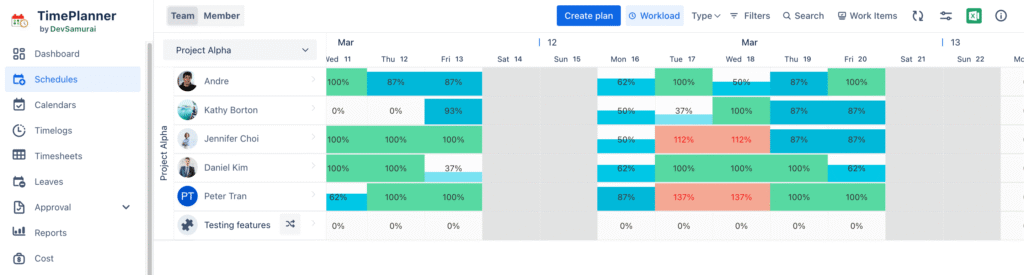
Before you assign a new epic or sprint task, you can immediately see who is green (has safe bandwidth), amber (approaching capacity), or red (overloaded). This allows you to distribute the workload equitably and sustainably based on hard, real-time data rather than guesswork.
2. Bridging the gap: Estimated vs. Actual effort
Overload is frequently caused by a math problem. Quantitative burnout happens when a task estimated by management to take two hours actually takes eight hours in reality. When these poor estimates compound across multiple tasks over a sprint, the employee’s week becomes mathematically impossible to complete within a standard 40-hour window.
To bridge this gap, TimePlanner utilizes integrated timesheets. Managers can then easily run variance reports that compare planned time against the actual time logged by employees. By tracking these patterns, agile teams can quickly identify systemic underestimations of complex work.
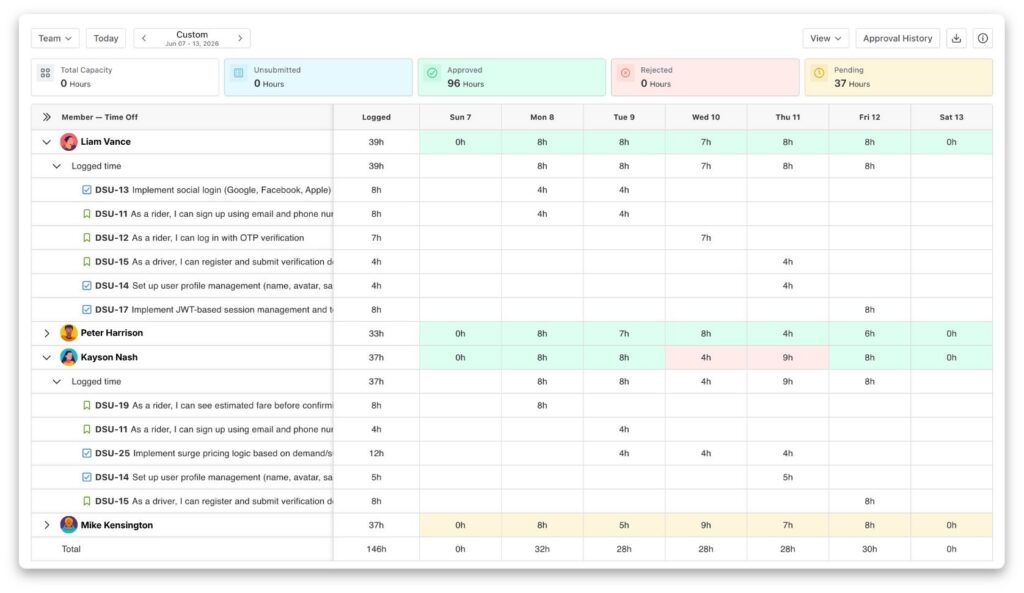
This data allows you to recalibrate your planning parameters for future sprints, entirely eliminating the accidental overload caused by bad forecasting.
3. Factoring in “invisible time” (Buffer & Admin)
Planning a workweek for 100% project utilization is a recipe for failure. It assumes that employees operate like machines, leaving zero room for checking emails, internal communication, mandatory HR meetings, or the severe cognitive cost of context-switching between tasks.
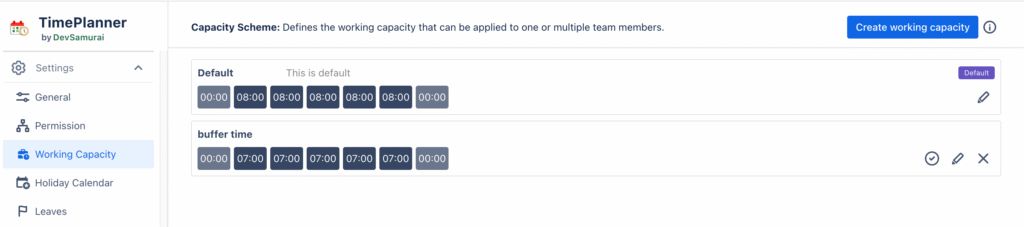
TimePlanner addresses this by supporting realistic capacity schemes. Instead of booking your team for a maximum of 8 hours, you can set a cap—such as allocating up to 80% of their hours to core project tasks. The system then automatically preserves that critical 20% buffer time.
Additionally, TimePlanner supports allocating non-working tasks, such as events or meetings. These activities are the easiest to overlook, but they can take up a big chunk of your employee’s time. So, when combining this with the “Show overtime signal” in the Schedules board, managers can quickly spot who is reaching the capacity limit.
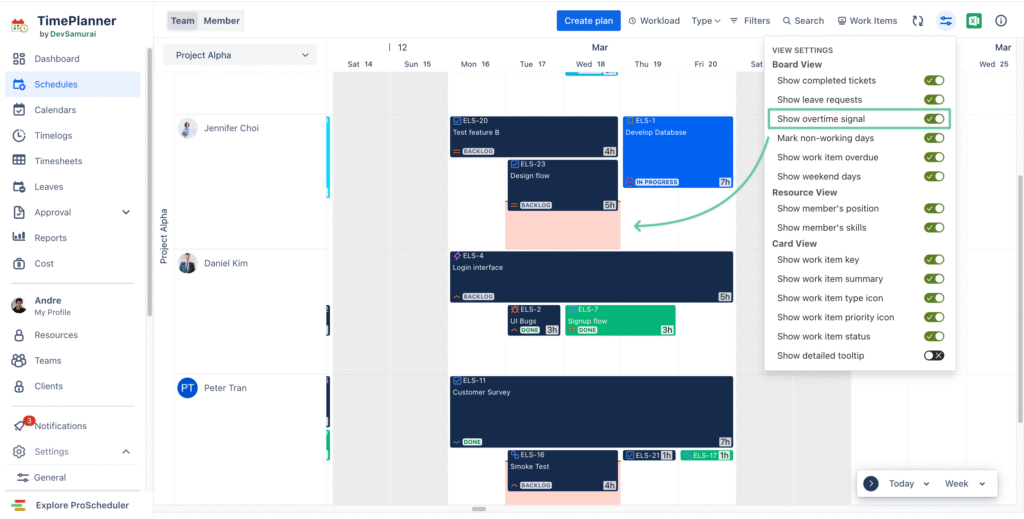
This ensures that administrative tasks and essential mental breathing room are built directly into the workday, rather than forcing employees to tackle them after hours.
4. Blending leave management with project scheduling
The domino effect of overload often starts when someone takes time off. When a team member goes on a well-deserved vacation, their remaining tasks are often dumped onto their immediate colleagues without anyone checking the remaining team’s bandwidth.
This turns a positive event—someone taking leave—into a punishment for the rest of the team.
TimePlanner prevents this by blending leave calendars with project scheduling. When an employee schedules time off, the system automatically flags the upcoming gap in team capacity.
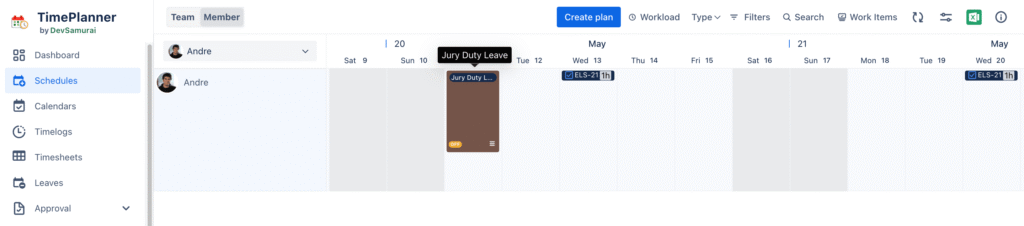
This foresight allows managers to proactively redistribute workloads, adjust sprint commitments, or push non-essential milestones before the vacation starts, keeping the remaining team’s workload perfectly stable.
Strategies to motivate your overloaded employees
If you identify that a team member is already overloaded, your immediate priority must shift to recovery. Once the workload is balanced using proper capacity tracking, how do you rebuild their morale and motivation?
- Clear the plates personally: Do not just tell an overloaded employee to “prioritize.” Step in as a manager and explicitly deprioritize, delay, or delete non-essential tasks from their board. Give them immediate, tangible relief.
- Re-establish psychological safety: Have an open conversation. Reassure your team that raising a flag regarding a heavy workload is viewed as a sign of professional maturity and strong communication, not a weakness or lack of dedication.
- Celebrate the “No”: Normalize and respect boundaries. Encourage your team to decline non-essential meetings and strictly enforce rules regarding out-of-hours communication.
- Recognize and reward recovery: Encourage your team to actually take their accumulated PTO. Crucially, as a manager, ensure their project responsibilities genuinely stop while they are away, allowing them to unplug entirely and return refreshed.
Conclusion
Employee overload is a structural imbalance that ruins retention, degrades product quality, and kills motivation. It is an operational roadblock, not an individual’s failure. As we navigate increasingly complex work environments, we can no longer rely on hustle culture or the resilience of our teams to make up for poor project planning.
Besides, preventing work overload requires a cultural shift backed by the right operational data. Moving away from guesswork and adopting transparent, accurate resource visibility is the only sustainable path forward for modern teams. By recognizing the early signs of burnout and utilizing smart systems to manage bandwidth, you protect your people and your business.
Ready to protect your team’s well-being and optimize your delivery cycles? Take the guesswork out of resource planning and try TimePlanner’s capacity management features today.